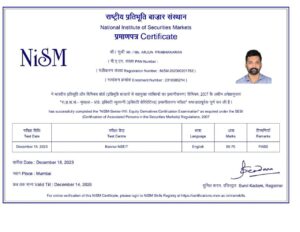
I’ve been trading the Indian stock market for over 8 years. And the number one question I get from students, from neighbours, from relatives at family gatherings is always the same: “How does the stock market actually work?”
Not the textbook version. The real version. The version that tells you why your friend lost money in three months but your colleague has been quietly compounding wealth for five years. That’s exactly what this guide is about.
WHAT YOU’LL WALK AWAY WITH
- A crystal-clear picture of how money actually moves in the Indian stock market
- Why BSE and NSE exist and which one actually matters for you
- The behind-the-scenes journey of a single buy order
- What SEBI does and why you should care more than you do
- The 3 biggest mistakes beginners make (and how to avoid them)
- A practical roadmap to start trading with confidence, not guesswork
If you’re serious about understanding the market, not just memorising terms but actually learning how to move with it, this guide is your starting point. Let’s get into it.
1. What Is the Stock Market? (And What Most People Get Wrong)
Most people think of the stock market as a casino, a place where you bet on numbers and either win big or lose everything overnight. That framing is not just wrong; it’s dangerous, because it shapes how you behave when you’re actually in it.
Here’s what it actually is: the stock market is a regulated marketplace where shares of publicly listed companies are bought and sold between investors. When you buy a share of, say, Reliance Industries, you become a fractional owner of that business. You’re not “betting”, you’re participating in the real economy.
Think of it this way:
Imagine a chai stall that becomes wildly popular. The owner decides to expand but needs capital. She divides the business into 1,000 equal parts and sells them to the public. You buy 10 parts. Now you own 1% of the stall. If the business grows, your 10 parts become more valuable. That, in essence, is what the stock market does at a scale of crores.
2. BSE vs NSE: India’s Two Stock Exchanges Explained
India has two major stock exchanges: the Bombay Stock Exchange (BSE) and the National Stock Exchange (NSE). Both are regulated, both are legitimate but they’re not identical.
| Feature | BSE | NSE |
|---|---|---|
| Established | 1875 (Asia’s oldest) | 1992 |
| Benchmark Index | Sensex (30 companies) | Nifty 50 (50 companies) |
| Listed Companies | 5,000+ | 2,000+ |
| Trading Volume | Moderate | Higher (preferred for F&O) |
| Best For | Long-term investing | Intraday & derivatives trading |
Pro tip: As a trader, I work primarily on NSE because of its higher liquidity especially for options trading. But both exchanges share the same prices for most stocks. If you’re buying TCS shares, it doesn’t really matter which exchange you use.
3. The Ecosystem: Who’s Actually Involved?
The stock market isn’t just you and your phone app. There’s an entire ecosystem running behind every trade. Here’s who the key players are:
SEBI (Securities and Exchange Board of India)
Think of SEBI as the supreme referee of the market. It makes the rules, watches for foul play (like insider trading), and protects you. Every broker, exchange, and listed company must follow SEBI’s guidelines. Without SEBI, the market would be the Wild West.
Stock Exchanges (BSE & NSE)
The marketplace itself. Exchanges provide the infrastructure such as servers, order matching systems, price discovery that allow millions of trades to happen every second. They also list companies through IPOs and delist those that no longer meet standards.
Depositories (NSDL & CDSL)
Where your shares are actually stored digitally. When you buy shares, they don’t sit in your app. They live in your Demat account maintained by either NSDL (National Securities Depository Ltd.) or CDSL (Central Depository Services Ltd.). Your broker is just the interface.
Stockbrokers
The middlemen between you and the exchange. When you hit ‘Buy’ on Zerodha, Angel One, or any other platform, your broker places that order on the exchange on your behalf. They charge a brokerage fee (commission) for this service.
Investors & Traders (You!)
The lifeblood of the market. Investors buy and hold for the long term. Traders buy and sell frequently sometimes within minutes to profit from price movements. Both are essential to a healthy, liquid market.
4. How a Trade Actually Happens: The Journey of One Buy Order
Here’s something most beginner guides skip: what actually happens between the moment you tap “Buy” and when shares appear in your portfolio. I’ll walk you through it step by step.
Step 1: You Place an Order
You open your trading app and place a buy order for 10 shares of HDFC Bank at ₹1,650. This is your intent, not the trade itself.
Step 2: Your Broker Receives and Routes the Order
Your broker’s system validates the order (do you have enough funds?) and routes it to the exchange (NSE or BSE) via their Order Management System (OMS).
Step 3: The Exchange Matches Buyers and Sellers
The exchange’s matching engine looks for a seller willing to sell at ₹1,650 or lower. When a match is found, the trade is “executed.” This takes milliseconds.
Step 4: Trade Confirmation
You receive an instant confirmation. Your funds are blocked, and the seller’s shares are earmarked for you.
Step 5: Settlement (T+1)
India now follows T+1 settlement. This means one business day after your trade (T), shares are credited to your Demat account and funds are debited. Previously this was T+2, SEBI moved it to T+1 to speed up the cycle and reduce counterparty risk.
Note: In my intraday trades, I’m in and out within hours (sometimes minutes). Settlement still happens at T+1, but the profits (or losses) reflect in real time in your P&L. This real-time visibility is what makes intraday trading so psychologically intense.
5. Market Hours, Segments & What You Can Actually Trade
The Indian stock market is open Monday to Friday (excluding public holidays). Here’s the session breakdown:
| Session | Time | What Happens |
|---|---|---|
| Pre-Market Session | 9:00–9:15 AM | Orders collected; opening price determined via call auction |
| Regular Trading Hours | 9:15 AM–3:30 PM | Live buying and selling; price discovery in real time |
| Post-Market Session | 3:40–4:00 PM | Closing price confirmed; limited orders allowed |
| After-Hours (AMO) | Varies by broker | Orders placed for next day’s opening |
What you can trade in India:
- Equities (Stocks) — Shares of listed companies like Infosys, Tata Motors, HDFC Bank
- Derivatives (F&O) — Futures and Options contracts based on stocks or indices
- ETFs — Exchange Traded Funds that track indices or sectors
- IPOs — Applying for shares of companies going public for the first time
- Bonds & Debt Instruments — Lower risk, fixed-income instruments
6. How Stock Prices Move: The Truth Behind the Numbers
Stock prices are determined by one fundamental force: supply and demand. More buyers than sellers? Price goes up. More sellers than buyers? Price falls. But what drives buyers and sellers? That’s where it gets interesting.
Key price movers in the Indian market:
- Company Earnings: Quarterly results like revenue, profit, margins move stock prices dramatically. Beat expectations? Stock rallies. Miss? It tanks.
- Macroeconomic Data: RBI interest rate decisions, GDP numbers, inflation (CPI) all impact market sentiment broadly.
- FII/DII Activity: Foreign Institutional Investors (FIIs) and Domestic Institutional Investors (DIIs) move large amounts of money. When FIIs sell, markets often fall. Tracking their activity is something I do every morning.
- Global Cues: Nifty doesn’t live in a bubble. US Fed decisions, crude oil prices, geopolitical events all ripple into the Indian market.
- Market Sentiment & News: A single tweet, a regulatory announcement, or a sector-specific development can move stocks significantly, often irrationally.
7. The 3 Biggest Mistakes Beginners Make (I’ve Seen All of Them)
After teaching hundreds of students at We Simplify Trades, these are the patterns I see again and again:
Mistake #1: Trading Without a Plan
Most beginners enter a trade because of a tip, a YouTube video, or a gut feeling. They have no entry point, no target, no stop-loss. Trading without a plan isn’t trading, it’s gambling. Every trade I take has three things defined before I place the order: entry, target, and maximum acceptable loss.
Mistake #2: Averaging Down Without Conviction
“It fell 10%, let me buy more!” This logic sounds smart but is dangerous if you haven’t done fundamental analysis. Averaging down on a losing trade without clear reasons is how small losses become portfolio-killers.
Mistake #3: Ignoring Risk Management
Position sizing, stop-losses, and maximum daily loss limits aren’t optional, they’re the difference between a trader who lasts and one who burns out. The market will give you losing days. Your job is to make sure no single day can destroy your account.
8. How to Start Trading the Right Way
Here’s the honest roadmap I’d give anyone starting from scratch today:
1. Open a Demat + Trading Account
You need both. Most brokers (Zerodha, Angel One, Upstox) offer them together. Choose a SEBI-registered broker only.
2. Learn Before You Burn
Don’t fund your account until you’ve spent at least 30 days learning the basics such as technical analysis, candlestick patterns, support/resistance levels. Paper trading (simulated trading) is your best friend at this stage.
3. Start Small, Think Big
Your first ₹5,000 in the market is tuition, not an investment. Start small, focus on learning, and scale only when you’re consistently profitable.
4. Find a Mentor, Not Just YouTube
YouTube is great for awareness. But when your money is on the line, you need someone who can show you how the market moves in real time not just in hindsight.
This is exactly what we do at We Simplify Trades, offering a practical learning experience through our trading course in Kannur as well as our online trading course, so you can understand the market as it unfolds.
5. Build a Journal
Record every trade. Entry price, reason, outcome, emotions you felt. This is how traders improve. The market is the best feedback machine in the world but only if you’re listening.
The Bottom Line
The Indian stock market isn’t a mystery. It’s a system, one built on supply and demand, regulated by SEBI, facilitated by exchanges and brokers, and powered by millions of participants like you.
Once you understand how the pieces fit together who the players are, how orders move, what drives prices, you stop fearing the market and start engaging with it intelligently.
The traders who succeed aren’t the ones with the hottest tips or the most money. They’re the ones who understand the game and play it with discipline, patience, and a proper plan.
That’s exactly what we help you build at We Simplify Trades.
Key Takeaways
- The stock market is a regulated marketplace, not a casino
- India has two main exchanges: BSE (Sensex) and NSE (Nifty)
- SEBI is the regulator that protects retail investors
- A trade takes milliseconds to execute; settlement happens in T+1
- Prices move due to supply-demand, earnings, macro data, and sentiment
- The 3 biggest beginner mistakes: no plan, averaging blindly, skipping risk management
- The right starting path: learn first, fund second, scale third